Friday, October 4, 2013

Through the Lens of Lepcha Folk Songs


Dr. Ramesh Chandra Mukhopadhyaya

The Himalayas are in the north of the Jambudwipa or the Indian peninsula.It is a snow-capped mountain range that serves as the crown of the holy land that is India. It is the abode of Lord Shiva or blessings personified. The word Shiva means benediction. From the Himalayas, love and kindness radiate in all directions like clouds and in the shape of benediction streaming down in countless rivers. Not only are the Himalayas the abode of snow and gods, the mountain range itself is a god of gods. And Uma  the demon- slayer, the goddess Durga is the offspring of the Himalayas. Since the Himalayas, the abode of gods is in the north, it has been often argued that the inhabitants of India whom one might call the Aryans after the western fashion had their ancestral home in the north only. Lokmanya Tilak posited that the original home of the Aryans was situated in the North Pole. But the snow-capped Himalayas could be a more reasonable ancestral home of the Aryans. No wonder that the nostalgic people all over the globe are drawn to the Himalayas. And of course the people who still linger in the lap of the Himalayas are their kins. It is always a pleasure to meet the people whose homes are the Himalayas. Because it is in them that the pristine purity of the first children of gods are still preserved.
This is a humble treatise that seeks to know the thoughts and the way of life of the Lepchas, a people whose home is the blessed Himalayas. To that end the present treatise seeks to decode the songs of those Lepchas which have been collected and magnificently edited by Lyangsong Tamsang Lepcha in the small volume, The Indigenous Lepchas and Their Songs.

But let us first ask –who is a Lepcha?  A Lepcha poet introduces himself thus—
Skilful in using and firing bows and arrows
And playing flute and bass and Lepcha guitars
Expert in using swords and pens
Observe me carefully
I am a Lepcha
The Lepchas who live in the territory lying between the Himalayas and Jalpaiguri and Nepal and Bhutan could be the people who still hold on to the primeval way of life and culture that is still sacred to us.  The towering gigantic mountains capped with pure white snow and green hills and valleys below constitute their landscape. Amidst hills and dales in the hoary Himalayas, they still sing and dance to the merry notes of Toot Fo and Paril Bu, Fodaong Fo and Tagrek Fo, their hearts lifted up to chant hymns to Kingtsoomzaongboo.
 The small volume of Lepcha songs opens with an invocation to Kingtsoomzaongboo. That is the mangalacharanam. The name Kingtsoomzaongboo is a symphony in itself. It is the Kanchanjungha or the treasure house of gold. Kanchanjungha stands for the golden Himalayas. And of course it is the creator of land and water. The bard knows that it is the genesis of the stars in the firmament. Hence it is the father of the world. And the Lepcha poet offers it Chyee or fermented beer.This reminds us of the Vedic rishis who offer somarasa to their gods such as Indra or Agni. In fact unless both the addresser and the addressee— the god and its votary are plunged in ecstasy, god’s plenty is not there. The Lepcha priest of a poet offers Chyee to Kanchanjunga—the creator of the Himalayas. He also offers Chyee to the hills and the cliffs. He lights lamps in array and burns incense in reverence to Kanchanjunga and to the hills and cliffs including mount Pandim and mount Graongkaa. Kanchanjunga will enlighten them and give them shelter. Mount Pandim and mount Graongkaa will bestow peace and tranquility upon them. The Himalayas that literally means in Sanskrit the deity who lives in the palace of snow shall bestow prosperity to these children of snow.
 Next comes the invocation to Naaraok Rum, the god of music. Because it is through the chanting of the songs that the Lepcha people, the children of the snow can preserve, and spread their very rich and ancient Lepcha culture for posterity. This is not all. Like the sacred confluence of Teesta and Rangeet ceaselessly flowing hand in hand in love and harmony towards the plains of India, the Lepcha culture should flow into the cultural realm of the Indian plains to awaken them to hopes and fears it heeded not.
The invocation to Kanchanjunga and the Himalayas and to muse over or the mangalacharanam over, the Lepcha poetry celebrates the birth of a child with invocation to the guardian spirits of birth and life. It is the guardian spirit of both body and soul. The poet prays to the guardian spirit of the child so that its future becomes as bright as the shining silver coin. The poet also prays to the goddess of Fortune so that the child grows to be an honest, virtuous and prosperous person. The poet asks the guardian spirits, Nunglen Nyoo and Kathaong Fee, to cleanse the new born baby and its soul and to drive away evil spirits, if any, in the child’s abode. The cleansing ceremony of the new born child is observed by way of sprinkling holy water and Chyee. Besides, a strand of seven threads is tied round the wrist of the child. Seven is the magic number which stands for the seven worlds-Bhuh, Bhuvah, Svah, Janah, Mahah, Tapah, Satyam in Hinduism. Once the strand of seven threads is tied round the wrist of the child, the poet of the priest announces that it is a complete human and an asset to the world. Thus the Lepcha community looks upon every birth as the increase in the asset of the world.
 Since every birth brings fresh hope, no wonder that the Lepcha community celebrates every marriage with dance, song and play amidst joy and delight. The bride and groom should live long like the Himalayas standing strong. Like the Teesta and Rangit – they must flow together, for ever with enduring love for one another. And they should bring forth fruits and flowers in bright sunshine in their bowers.
 During the Lepcha marriage, it is the jewel bride who is entrusted into the laps of groom’s parents. The uncles and aunts and relatives are the witnesses to the ceremony. The jewel bride carries light with her when she migrates to her new home.
Any marriage is like the wedding of the rivers Rangeet and Rongnyoo. Toot Fo, the legendary bird of the Lepcha mythology, leads Rangeet, the groom, while Paril Bu, the dragon snake, leads Rongyoo or the Teesta,   the bride to their wedding at what we call the confluence of
 Teesta and Rangeet. Thus every marriage in Lepcha community is a charmed one where Nature divinities preside. And just as every confluence generates great energy so does every marriage hold out great promise. The rivers Teesta and Rangeet once united flow downwards to enrich the plains. So does the Lepcha community carry the torch to light the world. No wonder where ever they go there is the dawn.
Lepcha literature is very rich in songs of love. The lover and the lass join in enduring bond like the Teesta and Rangeet. Their love is loud likening the humming of the bumble bees. Their love flows like cascades down the mountain side. The wife carries water in a bamboo cylinder to quench the thirst of her husband and waits near  the Sambraang trees . Sometimes the world is not a fitting place for true love to consummate. Hence the lovers wonder where could they place their love and union of two bodies! The woman tells her lover——
If you jump into the burning fire
I will also jump upon it
If you jump into waters
I will also plunge into it
This is befitting heroic poetry and romance.
The Lepcha songs celebrate every new birth and every wedding and every spring with a view to realize a brave new world.
With the advent of spring the cuckoos of different families, the Naam Fraong Fo ,Tukpo Fo , Tukvyer Fo,  cry Kaa koo koo! Kaa koo koo! Oh the beloved children of Mother Nature and God! Oh you Lepchas!This is the time to commence work. This is the time to sow Jo Po Maar rice and Jo Po Chyong rice.
And every New Year they rejoice because when the first bamboo shoots originated in this world and when the broom grasses originated in this world the Lepchas likewise originated. The Lepcha poet claims-the Lepcha, bamboos and broom grasses are alike.
  This is the message of the Lepchas to the world. This is the voice of Nature and God revealed to the Lepchas. Unless the world pays heed to the voice of the Lepchas, it is foredoomed to utter annihilation. Christianity exhorted that man is the crown and coping stone of the creation. The Bible asks man to lord over Nature. Hinduism in its later years revelled in one God that impels all thinking things and all objects of all thoughts and runs through all things. While Christianity in its craze for the conquest of Nature has made nature out of joints, the Hindu’s craze for the conquest of inward Nature has made them other-worldly, aloof to the travails of the world. The murky clouds of air pollution hang heavy in the skies above the Earth. The pollution distorts Nature the creation of God in a lamentable way. The Chyakmong Fo was given golden beak and golden wings and emerald necklace by God himself   But the bird laments——
Fellow birds snatched away
My emerald necklace and golden wings
I hid my golden beak
I hid my golden legs
Dipping them inside a marshy place
And to this day
My golden beak
My golden legs
Only remain in one piece.
We should remember that our dear Earth is the only space-ship where we could live. If this space-ship of ours is suffused with pollution generated by modern science, technology and the spirits of globalization, we humans have no other place to hide our heads.
Indeed earlier when the so called modern civilization had not raised its hydra head felling trees, dynamiting mountains, sending smoke to the skies, the Porcupine could say
During Sambryaang glyock
A time when it is the hottest
I stay secure in my burrow
But right now the son of man has no shelter where he can hide his head.  True love has no place where it can flourish and fruitify.
Hence the Lepcha lover laments-
I tried to place our love
On a tree
But the tree fell
I tried to place our love
On the land
But it subsided away
 Right at this moment every one of us should chant the mantra –we the humans, bamboos and broom grasses are alike. It is from the Lepcha culture that we should derive the realization that we men and the Nature are one. We men and the grasses and the rivers are close kins. Nature worship should be the religion of the world. We must chant to the tune of Lepcha poet and pray with folded hands
The master of land
The master of water
The master of kingdom birds
We extend our warm welcome to you
To bring fresh air and sunshine to our doorway
 Neither reverence for Brahman nor worship of God the Father could help us in the face of the crisis of civilization. We must learn from the Lepcha people the worship of the different forces of Nature and her many creations separately. Philosophical abstractions, do not help us to live in the real world, the world of the contingent. Once we get rid of our abstractions there could be a world where we could take refuge and where true love could prosper.
 To born is to die. Every birth implies death. But the Lepcha bard reminds us that one must not grieve for that. Because to be born and to die is the way of the world and it is decreed by the almighty God. Even the Sun and the Moon were once almost eaten away by Daar Sathong in the olden days. Hindu mythology dwells on how the Dragon’s Head or Rahu eats away the Sun and the Moon from time to time. When the Sun and the moon are eaten away it is called the eclipse. The Lepcha poet reminds us that even the Sun and the Moon are eaten away. Landslides occur on the mountains and the hills. Wildfires destroy the forest. Storm blasts mow down the trees. The day becomes night. The daffodils that burst forth with the day break droop when the barred clouds bloom the soft dying day.
The Lepcha poet says –
We are born to die
It is the rule made by the Almighty God.
The Lepcha mind is aware of the brief stay of man on earth and of the transitoriness of everything in the world and of the world itself. The western culture reacted to this transitoriness of the world preaching Epicureanism——Drink Life to the lees; eat drink and be merry. But the Lepcha reaction to the awareness of the transitory nature of the world is different. This has been depicted in a powerful lyric entitled Human Life. True that man’s life is as short as the stay of the morning clouds in the sky, the stay of the flower in the garden or the shiny dews in the arum leaf. But in that case man should be as beautiful as the flower in efflorescence as the cloud aglow in the morning sun or as the dew drops deposited at dawn dazzling like diamonds. In short man should make his life as beautiful as possible within the short span of life. He must not look forward to any life beyond death and leave his duties for tomorrow. Hence the poem Human Life exclaims over and over again that no one knows the future. True that life is short. But we could make life here and now as beautiful as that of a flower or a cloud or a dew drop. The Lepcha poet knows that the world is also transitory. But it is not harsh. It is like the garden where flowers bloom. It is like the arum leaf in which the dew drop shines. On another level the world is like the skies blue and boundless. There we appear like trailing clouds of glory emanating from the god of gods Kanchanjunga or Kingtsoomzaogboo. But our lifespan is as short as the stay of a dew drop on the arum leaf or of the cloud in the skies or of the flower in the garden. The Lepcha poet reminds us that nothing can be taken from the world. We come naked here and we go naked hence. This is what a Hindu has to realize to become a sannyasin. But the Lepcha people have an innate realization of this truth. They did not learn to possess. Food clothes and shelter are all that these children of Nature look forward to.They are the tribe of sannyasins withal. In fact it seems that the earliest stage of human civilization was predominated by the tribes of sannyasins who lived on roots and fruits whatever Nature gave them out of her bounty. With the roll of time man gradually drifted far off from this truth. It was the love of possession that brought about what we call civilization. It was the lust for possession that made man more civilized and the architects of the two Great Wars. The Lepcha poetry lingers on earth to remind us of the truths that awake during the childhood of human civilization to perish never.  
While meditating on death and transitoriness of the world Lepcha songs are deeply philosophical. The world where we live is like an arum leaf and we are dew drops in it with our megacities and shopping malls. This shows that the Lepcha poet is intuitively aware of the multiverse where countless universes twinkle for a moment and then vanish .But the Lepcha poet reminds us that our thoughts on life are greater than the stars in the skies. They are not as short-lived as our life on earth or as the life of stars as well. The Lepcha poet wants us to wake up in the truth that the body might die but our thoughts do not and our souls do not. And we must find our way to Poomju or make it.The Lepcha poet tells us   -
      From time immemorial
      The Beloved Children of Mother Nature
      Your ancestors are waiting
     At Poomju your home in the Himalayas
     With arms open
The Lepcha people do not have any notion of hell. Because they do not have any positive law. Positive law always speaks of negation—This thou must not do….. Or….That  thou must not commit. But is there any positive law to rule the family?  Each member of a family knows what his dos and don’ts are. To that end any enactment of law has not been necessary. Similarly the Lepcha people needed no positive law and no one sins among them. With the advent of civilization positive laws were enacted and sins were born, jails and hells were created. Lepcha poetry could lift up our souls to the heights beyond the dichotomy of modern civilization - to the heights of Poomju.
Dzongu of Sikkim -green woodlands lorn with orchids in full bloom surrounded by the snow-clad summits of the Himalayas is the incarnation of Poomju upon earth. Dzongu is to the Lepchas what Jerusalem is to the Christians and Vrindavana to the Vaisnavas.
But it is a pity that modern civilization is out to destroy the sacred niches of man. Every nation, every culture has the right to live in this world. This is what the human rights and the UN Charter profess. But it is a necessary charecteristics of modern civilization to preach what it does not practice and to practice what it does not preach. It is all for large populations and for large quantities and abstract notions where individuals are ignored, small ones are ignored and quality is ignored. When churches, temples and mosques are desecrated there is a worldwide furore but when the lonely splendour of the sacred Dzongu is molested, when the sacred rivers springing from the heaven, Rangeet and Teesta are dammed, no voice of protest could be heard from the UNO, from the Human Rights organizations. This is because the Lepchas do not have political power or money power or muscle power. Theirs is a small community. The world does not know that small is beautiful. Even a small community could achieve great things. But the world is forgetful of that. The world is more concerned with communism, capitalism, pantheism and the like and never pays heed to the small and the individual and the individual’s beliefs. The world might take care of the vast Buddhist viharas and cave paintings of Ajanta and Ellora where may be snakes and fairies are carved. But real forests, the real mountains and their caves with real pythons and cobras, the truly holy places haunted by gods and fairies, sacred and secluded are sacrileged in the name of democracy and development.
Consequently the Yel Malee bird darting here and there in the evergreen forests generations succeeding generation finds its ancestral home and traditions encroached and tampered and mutilated and transgressed. The bird complains that many a hunting birds have migrated into its ancestral land. They try to drive away the Yel Malee bird from its homeland. Besides there are alien birds come to its native forest that breed so many youngs that the native birds of the forest become outnumbered. The Numprick Fo birds have arrived in the native land of the Yel Malee. The latter have been made to forget their native tunes, notes, songs and dances by the stranger Namprick Fo birds. This is a cruel allegory. It speaks of how the Lepchas have been outnumbered in their homeland because of strangers migrating there. Their native religion, native tongue, native dress, in short, their native way of life is being made out of joints. What is true of the Lepchas is true of the Maoris of Newzealand or the Red Indians of America. But this is not all. Human race all over the world is being uprooted from its tradition along with the flora and fauna of the earth. Yel Malee Bird gives a tongue to the groans of the existence.
The small volume of Lepcha songs has, structurally speaking, four distinct parts. It opens with invocation to deities that belong to Nature itself. They are not the gods of the hills or lakes. The hills and the lakes and the rivers are themselves gods. The Mount Kanchanjunga is the god of the gods. The snow-capped Kanchanjunga is what the philosopher Emmanuel Kant calls sublime. It is so vast, it is so great, it is so effulgent, it doffs and dons so many hues, it excelsiors the forests and hills and reaches such dizzy heights touching the skies that it baffles our imaginations. It is something that is beyonds our imagination. This Kanchenjunga is the creator of the universe. Presently after the invocation, the most significant rituals in the life of the children of snow, the Lepchas such as their birth, marriage and death have been delineated with great vividness. Meditation on death and the transitoriness of the world have led the Lepcha bard to dwell on eschatology. Although the Lepcha poets celebrate the union of bodies, they do not fear death in a song which we have already referred to. The hero goes off to death in an attitude. The heroine is ready to leap into fire for her sweetheart’s sake. It appears that the Lepcha bards believe in a soul that survives the body. Presently after death the soul returns to the ancestors. The latter welcome the soul with stretched arms.  But this is not all.
In a song a bird recounts its previous birth. It suggests that the Lepchas, the children of snow believe in transmigration of the soul. In the third section of the volume of the song, the Lepcha lyricists speak in the parole of the birds how they are being out numbered by strangers migrating into their land. The Lepcha poets bemoan the fast erosion of their traditional culture their language, their clothes, their age-old beliefs, in short, their ways of life. The use of the persona of the birds to give a tongue to the groans of the Lepcha people speaks of consummate Lepcha poetic art. It would be very sentimental if the Lepcha poets had spoken in their own person or parole of the desperate situation into which they have been thrust by blind fate or by history. But the story of Lepcha people and culture is not destined to end in laments. Hence the fourth part of the volume of songs.
The Lepcha poet celebrates the Lepcha New Year with fresh visions. The youngs move from one house to another in the Lepcha villages announcing that the Lepcha New year had come. They must awaken to the exigency of the hour to uphold Lepcha values, Lepcha culture, Lepcha tongue and the like. The youth must take the oath that they would keep up their Lepcha identity. They should remember their glorious past. The Lepcha people never invaded the native place of any other people or culture. But when the King of Bhutan attacked Lepcha habitat, the Lepcha king Pano Gaeboo Achyok of Damsang heroically resisted the invaders. The Lepcha people had built impregnable forts to defend their motherland from foreign aggression. The Lepchas fought under the command of King Gaebo Achyok and braved death like heroes. The Lepcha poet tells us that the King Gaebo Achyok though physically dead is still very much alive in spirit. He is with the Lepchas in their battle for identity and survival against the invaders who seek to wipe the Lepcha culture from the cultural map of the world. With this battle cry the volume of songs ends. This clearly speaks of how deftly  the editor once upon a time a Major in the British Army arranged the folk songs thematically as it were in a battle array. Hats off! Major! The readers are now waiting with bated breath to witness the heroic war on the cultural and spiritual plain for the identity of the Lepchas.
But the volume is not meant for the Lepchas only. Under the impact of modernization, globalization, capitalism, science and technology every culture, every people in the globe faces identity crisis . And the volume of Lepcha songs under study raises battle cries against this dehumanizing situation of the world.


Aachuley!


Wednesday, March 6, 2013

This ‘Mayel Lyang Lepcha Development Board’


Government of West Bengal 

Backward Classes Welfare Department 

Writers’ Buildings, Kolkata – 700 001 

Website: www.anagrasarkalyan.gov.in 

Kolkata, the 12th February, 2013 

                                                                  RESOLUTION 


No. 462-BCW/6S-73/2011.- Whereas it is considered expedient to establish a 
Development Board for the Lepcha community of West Bengal, the Governor is hereby pleased to 
establish a Board by the name ‘Mayel Lyang Lepcha Development Board’ with its Head Office in 
Kalimpong, District Darjeeling, West Bengal, under the administrative control of the Backward 
Classes Welfare Department, Government of West Bengal. This ‘Mayel Lyang Lepcha 
Development Board’ shall be registered under the West Bengal Societies Registration Act, 1961 
(West Ben. Act XXVI of 1961). 

1. The aims and objects of the Board shall be: 
(a) to undertake all necessary activities for the protection, promotion and safeguarding of the 
Lepcha language, tradition and culture; 
(b) to 
undertake activities to protect historical and culturally significant landmarks of the 
community; 
(c) 
to provide support to museum, community radio, publishing unit and mass media units; 
(d) to undertake activities to popularize, promote and enhance products of artisans, farmers 
and other tradition based items and help the artistes and artisans engaged in traditional 
activities; 
(e) to protect and promote customary rights of the community; 
(f) 
to establish a centre for the protection of the Lepcha heritage; 
(g) to take up social welfare activities catering to the requirements of the community; 
(h) to promote education among the Lepcha community; 
(i) 
to publish or cause to be published useful literature, papers, books, research works, 
magazines of the Lepcha community etc; 
(j) 
to work in association with all Government agencies for awareness generation regarding 
various programme of development and social welfare, education, literacy etc; 
(k) to 
undertake necessary activities for natural resource management, alternative energy, 
ecology and environment; 
(l) 
to construct, maintain, improve, develop, any building, houses or other infrastructure and 
purchase land and other moveable and immovable assets for the benefit of the 
community; 
(m)to 
set up mobile health unit, village health centres and to promote Lepcha medicinal 
practices; 

(n) to take up livelihood development of the community; 
(o) to undertake and provide legal assistance to protect assets of the community members; 
Page 1 of 5 


(p) to raise loan and credit to fulfill the objectives from national and international financial 
institution, subject to observation of statutory rules and executive instructions; 

(q) to obtain fund from different Government departments for fulfillment of the aforesaid 
objectives; 
(r) to undertake activities for the overall development of the Lepcha community throughout 
West Bengal; 
(s) to do all such acts, deeds, matters and things connected thereto and therewith as may be 
necessary or deemed to be necessary as well as incidental or conducive to the foregoing 
objects. 
2. The following shall be the authorities of the Board, namely, - 
(a) General Body and (b) Executive Body. 
3. General Body.(
a) The General Body shall initially consist of not more than thirty-one (31) members to be 
nominated in the following manner;- 
i) Chairperson -(to be nominated by the State Government in the Backward Classes 
Welfare Department from among the Lepcha community to be decided on the basis of 
recommendation of the largest recognised society or organization of the Lepcha 
community of West Bengal); 

ii) Vice-Chairperson - (to be nominated by the State Government in the Backward Classes 
Welfare Department from among the Lepcha community to be decided on the basis of 
recommendation of the largest recognised society or organization of the Lepchas of 
West Bengal); 

iii) Member-Secretary - one officer appointed by the State Government on deputation; 
iv) ex-officio member -District Magistrate, Darjeeling or his representative; 
v) ex-officio member -District Welfare Officer, Backward Classes Welfare Department, 


Darjeeling; 
vi) ex-officio member -Director, Cultural Research institute or his representative; 
vii) other members to be nominated by the State Government from among the Lepcha 

community to be decided on the basis of recommendation of the largest recognised 
society or organization of the Lepchas of West Bengal. 

(b) Meeting of the General Body.The 
General Body shall ordinarily meet at least twice a year on date, time and place to be 
fixed by the Secretary in consultation with the Chairperson and shall: 


i) adopt the annual report of the preceding year; 
ii) pass the audited accounts and budget estimates and; 
iii) transact any business as well be placed in the agenda suggested by the executive body. 


Page 2 of 5 


(c) 
Extra – ordinary meeting.An 
extra-ordinary meeting of the General body may be called by the Secretary, in 
consultation with the Chairperson and at the advice of the Executive body when needed to 
transact any special business or at the requisition signed by at least ten (10) members of 
the Board. The Chairperson shall convene the requisitioned meeting within thirty (30) days 
from the date of the receipt of the requisition. If the requisitioned meeting fails to attain 
quorum, it will not be adjourned and will be treated as failed. 

Notice of the place date and hour of any meeting and of the business to be 

transacted shall be issued to the members of the board at least seven (7) days before the 

date so fixed for the meeting. 

(d) The following procedures shall be applicable to all the meetings of the General Body.i) 
One-fifth of the members shall constitute the quorum. If there be no quorum, the 
meeting shall stand postponed to a date to be fixed by the Chairperson. A fresh notice 
shall be issued and if there be no quorum again those present shall be competent to 
transact business. 

ii) The Chairperson or in his absence the Vice-Chairperson shall take the Chair. If neither 
the Chairperson nor the Vice-Chairperson be present the members present shall 
nominate a President for the meeting from amongst them and transact the business. 

(e) The power and duties of the General Body shall be as follows.i) 
to provide guidelines of the activities of the board in conformity with the objects 

defined; 

ii) to consider and adopt annual report of the board; 

iii) to consider and approve the audited accounts and the budget estimates; 

iv) to appoint auditor for auditing the annual accounts. 

4. Executive Body: 
(a) The Executive body consisting of not more than eleven (11) members shall be constituted as 
following by the Government from amongst the members of the general body, namely,i) 
Chairperson -to be nominated by the State Government in the Backward Classes 
Welfare Department from among the Lepcha community to be decided on the basis of 
recommendation of the largest recognised society or organization of the Lepchas of 
West Bengal; 

ii) Vice-Chairperson -to be nominated by the State Government in the Backward Classes 
Welfare Department from among the Lepcha community to be decided on the basis of 
recommendation of the largest recognised society or organization of the Lepchas of 
West Bengal; 

iii) Member Secretary - one officer (senior IAS officer) appointed by the State Government 
on deputation; 

Page 3 of 5 


iv) ex-officio Member - District Magistrate, Darjeeling or his representative; 

v) remaining 7 (Seven) members to be nominated by the State Government from among 
    the Lepcha community to be decided on the basis of recommendation of the largest 
    recognised society or organization of the Lepchas of West Bengal). 

Provided that the State Government in the Backward Classes Welfare Department may 
nominate such other persons, as it may consider necessary for smooth and proper functioning 
of the Board as members of the Executive body, who will also be members of the General 
Board. 

(b) Meeting of the Executive body: 
i) the executive body shall ordinarily meet four times in a year and the quorum of such 
   meeting shall be six (6); 

ii) an extra – ordinary meeting of the executive body may be called at the requisition of at 
    least six (6) members of the Executive body to transact any special business. The 
   requisitioned meeting shall be convened within fifteen (15) days from the date of 
   receipt of the requisition. If the requisitioned meeting fails to attain quorum, it will not 
   be adjourned and will be treated as failed; 

iii) notice of all meetings of the executive body shall be issued at least seven (7) days 
   before the date fixed for such meeting. 

(c) The power and duties of the Executive body shall be as follows.- 
i) to manage the affairs of the body and for this purpose to constitute committees and / 
or sub-committees consisting of the members of the body and to frame and adopt 
such regulations, bye-laws and pass such orders as may appear conducive to and 
necessary for the efficient administration of the board and the attainment of these 
objects provided that such regulations shall not be repugnant to these regulations and 
shall be reported to the general body. the executive body will constitute a committee 
or sub-committee to be headed by the chairperson or the vice-chairperson for overall 
development of the Lepcha community; 

ii) to prepare and place before the general body and annual report, the audited accounts 
     and the budget estimates; 
iii) to manage all the moveable and immoveable properties belonging to the board; 
iv) to acquire and accept in the name of the board any property (moveable and 
     immoveable), articles, donations and gifts; 
v) to keep accounts audited and the budget estimate prepared, to do all other acts and 
  deeds as shall be necessary and relevant in furtherance to the objects of the board; 

vi) to pay out of funds belonging to the board or out of any particular part of such fund, 
   the expenses incurred by the board from time to time including expenses for the 
   formation of the board and management of administration of the foregoing objects, 
   including all rent, rates and taxes, outgoing and salaries, allowances including fringe 
   benefits of the employees. The fringe benefit of the employees will be fixed in 
   consultation with the Government. 

Page 4 of 5 


Page 5 of 5 


Tuesday, February 19, 2013

From the Footway of Hills to the Labyrinth of Megalopolis: The Lepchas of Kolkata*


Part I
T.K. Das

If one lives in the vicinity of the housing complex of central government in Tollygunge, Kolkata, he would little bit be surprised to see some faded posters depicting the bust of an unknown recusant, King Pano Gaeboo Achyok. It also contained a call for a show of unity among the Lepchas through celebration of 20th December birth anniversary of the King at Kalimpong. Almost the same posters I have found in the Lepcha villages situated faraway even from Kalimpong. Have you ever thought of the spatial distance lying in between the two sets of posters? Perhaps not.

My long stint with the Lepchas and their affectionate gesture allure me to go deep into probing of the community outside the Mayel-lyang. So, I question the spatiality: its historical and causal dimensions, which I hope would enrich many of us. However, one has to start from a scratch as no such precise and informative write-up is found for our avail. Besides, it is said that the Lepchas are homesick and have phobia of roads or say mobility and so you cannot find them in a city of roads. The Lepchas are not so stereotyped nowadays but what they did in 19th century Calcutta is an enigma. This is my second question.

In 1767, Clive got the Diwani (an equivalent to post of the minister-in-chief) of Bengal, Bihar and Orissa and within a short period the East India Company promoted its trading interests around a group of villages by the river Ganges: Gobindapur, Sutanuti and Kalkatta. Later, these three villages transformed into the city of Calcutta. Decades later, in the first quarter of the 19th century Calcutta became an attractive place of emigration for trade and growing urban character. On the one side, the native Indians from different states assembled for livelihood and, on the other side, foreigners from all over the globe came and settled for political interests, missionary works and business. I found none of Lepcha origin there. It looks absurd indeed to expect some of them but, no way, the process of colonial migration has forced me to sense at least the thermal existence of the Lepchas in colonial Calcutta. If one thinks of the hasty process of colonial consolidation in Bengal he must agree that this process requires displacement of population, forced or otherwise, for building a colonial space for British rulers nurturing in a land situated thousand miles away for home. Some displaced Lepchas could be driven to Calcutta in this process. I shall later explain it elaborately with reference to the causes of migration.

In 1835, Darjeeling was colonized by the British agents. Kalimpong followed the suit in 1865. The old literature on Darjeeling profusely described the pace and character of colony-building in the hills and it essentially required manpower. British agents not only employed people for infrastructure building and defence but also engaged in producing skilled manpower for maintenance and preservation of colonial rule (e.g., teachers, doctors, nurses and workers for Christian missions). There was a third almost invisible sector, the domestic space, where natives were engaged in English households (e.g., as gardeners, ayahs, servants and maid servants and bearers). 
 
It is difficult to cite the proper chronology of migration of the Lepchas to Kolkata. I assume I will find the Lepchas in these second and third sectors visited or migrated to Calcutta for survival and good living. I have first found them in the private records of the early 20th century. However, when I chance upon some other data sources, to my delight, I have identified one mission worker in Calcutta as early as last decade
of 19th century. Later, few more have reached Calcutta either for mission works or for medical training. Whatever the profession, it is certain that colonial masters brought them to the capital. Many of them later returned to Darjeeling hills. There was another section of the Lepchas, who stayed in the twilight of turbulent Calcutta transforming from villages to colonial city of concrete, crime, babus, baijis, banias and downtrodden. I still cannot identify this hazy population and it is an unfortunate legacy: even in the 21st century I fail to reveal who they, the thriving Lepchas of Kolkata were/are. It is also not known to me the ethnic identity and fate of the 36 hill coolies who are sent to a Calcutta shipping agency, the Gillanders, Arthbuthnot & Company, for dispatching to distant land as bonded labours for work in tea-coffee-sugar plantations. So, the Lepcha community has an urban history of more than hundred years in Kolkata.

I

The population count (the number of people and speakers) of the government agency first reported of the Lepchas in the first decade of 1900. The total number did not cross double digits even in the next decade and none of them was female. In 1930s, it meagerly crossed three digits and the Lepcha women surfaced in the city of Calcutta. However, the count was not of continuous series. No data was found available in 1940s, 1990s and 2000s. Till 1980s, it remained again within single-double perimeter. So, the trend of Lepcha population was disheartening and it was difficult to produce a holistic picture of presence of Lepcha population in Kolkata. It also exposed the negligence of the colonial state which otherwise fanned with their anthropologists to generate knowledge about its subject population. There was only one silver-line beyond that gloomy picture. Since 1950s, the surrounding districts of Calcutta showed increasing trend in Lepcha population in comparison to the Calcutta proper. Although, the numbers were still vacillating between single and double digit mark, it could be significant with reference to spatial distribution of the population. True to the fact, only three districts out of 11 did not have any Lepcha population but the Lepchas had spread over eight districts including Calcutta within a short span of time after independence. However, while only the districts of Hooghly and 24 Parganas showed double-digit presence of the Lepchas, Calcutta remained within single digit number. At present, out of 141 wards of the Calcutta Municipal Corporation 6 have no scheduled tribe population and 31 wards have 100-628 scheduled tribe population. However, it is not known how many of them the Lepchas are. I can only produce the fact that three Lepcha females and four Lepcha males are found in wards xvii, xxii and xxxii of the Calcutta Corporation in 1950s.
For the present, I have tried to collect views of the Lepcha insiders for preparing a balanced datasheet on the Lepchas of Kolkata. It is interesting but unfortunate that, quite like its Kalimpong Headquarters, no such categorical information is kept by the Indigenous Lepcha Tribal Association (ILTA) of Kolkata Unit. Hence, I assume, keeping in mind the opinions of the office-bearers, about 500 Lepchas are living in and around Kolkata including the number of the floating Lepcha population coming and going for education, government service and private jobs. To some knowledgeable Lepchas, it is indeed hard to count the number of urban Lepchas. This inability again drives me to observe that Lepchas of Kolkata is devoid of close community network as found in some other ethnic groups living in Kolkata. There are many others, who in spite of their microscopic existence eagerly maintain the link with the other members through various communication networks. In such a vast urban space like a megalopolis Kolkata, it is really difficult but not impossible to maintain interactions. In the age communication, such communication failure is not at all conducive to their survival as “decentered” existence always encroaches upon cultural edifice of the community. Moreover, the causes of concentration of the Lepchas in a particular place like rural areas of the district of Hooghly are beyond my knowledge. So, the ‘spatial dimension — physical location of members and relations among them’ not only define its character but also its effectiveness to survive as a community.


II

Migration of people and communities is the most primal phenomenon of human history. It is universally the most stressful act destined for the human beings as well. Reasons are varied: natural calamities, painful expelling, persecution, job seeking and so on. In case of the Lepchas, apparently, seeking employment and related training had been the causes of migration. However, making of a colony in Darjeeling hill areas was the primary concern of the colonial rulers and the Lepchas and other hill communities had to follow process. For instance, the educated Lepchas of Darjeeling and Kalimpong had been trained in Calcutta for recruitment in professions like, doctors, nurses, teachers, clerks and clergies in the hills and plains of colonial India. Beside this service sector, I assume that migration of the Lepchas as servants and maids of the colonial masters cannot be ruled out. According to some scholars, ‘after settlement of the colonizers, the first wave of migrants to the city did not come to work in factories, but to service the lavish lifestyles of the Europeans, namely, the British. As domestic services were needed from early morning to late night, the poorest migrants found jobs easily in the colonial city, namely, in the area, known as ‘White Town’, the area of European settlement. The migrants from the nearly suburbs and provinces settled in hovels growing like mushrooms within the walking distance of the most luxurious areas of the city. Most of these migrants found jobs as gatekeepers, cleaners, gardeners, cooks, washer-men etc and a large number of natives of adjacent districts also found employment in Calcutta as shopkeepers and clerks.’ The reports and other write-ups of the Englishmen often regarded the Lepchas fittest for such menial jobs, especially as ayahs and gardeners. So, the identity and existence of Lepchas of Calcutta initially owed to this colonial rule. Later, they had also been engaged in white colour profession. This trend has been continuing even after independence. The Lepchas come to Kolkata for jobs, for education and for training.  And in many cases, the families follow; their children get acclimatized with the speed of the city-life and buy space for living. A different and recent explanation has been put forward that ethno-political turmoil in Darjeeling hills may indeed be a justified reason of migration. Political crisis, which is really unbearable for the marginal Lepcha community, in the homeland, therefore, encourages migration.
III
An economic advantage often induces migration. The migration of the Lepchas to Kolkata was primarily fallout of many events. Series of colonial invasions in their homeland severely disturbed their pristine society. Migration of the Lepchas in successive decades to different places was an attempt for survival. The thwarted process of economic development in the hills, a corollary to general misrule was the secondary cause of migration. However, nowadays the Lepchas of Kolkata positioned in different rungs of the urban economy is now a little advanced warrior struggling for better livelihood. In the early days of their city life, they had been mostly engaged in menial jobs. The government reports of the first half of the 20th century showed that Lepcha menial workers of various types lived in Calcutta and its surrounding areas. Among them, menial workers were the majority (64%) and very few of them (6%) belonged to the white colour professions. There was no doubt that the early Lepcha inhabitants of Calcutta stood at the lowest strata of economic hierarchy. The literacy rate among the Lepchas of Kolkata, in the early years of same century, also supported the view that they could not go beyond menial jobs for poor literacy rate. Most of them (97.87%) were illiterate.
Later, they joined in service sectors and became professional and trainee (doctor, for example) ‘clerks, teachers, nurses and dispensers in British India’. So, we have found an occupational shift from menial to mental or white colour profession. Presently, they are either employees of private and public institutions or engaged in business. Some of them work in the police or EFR or in defence establishment. A section of Lepcha youth come to the city for education and other job related training. No data on the Lepcha land ownership, except awfully few, in the city have been found available for study till date. The nature of jobs also determines the locale of the Lepchas of Kolkata. To some Lepchas, the nature of spatial concentration has really been regulated by functional or professional categories. According to a knowledgeable Lepcha, the nature of service determines the place of Lepcha residence in Kolkata. For instance, those Lepchas engage in police service or armed forces usually live at Barrackpur; those who are at EFR stay at West Midnapur and some of them reside in the Defence Estates like Dum Dum and Ichhapur. The Lepchas of Kolkata proper mostly engage in government jobs. Few have non-government assignment as well. Above all, it is a movement for survival by adopting different occupations as and when possible.


IV

Religious identity of the Lepchas of Kolkata is an interesting object of study for various reasons. Like any other ethnic community, the Lepchas are religious in their own way. However, colonial subjugation under different rules has changed their religious mosaic into the Animist, the Buddhist and the Christian schools. In many cases, a critical combination of all three schools or at least of two can also be felt thriving among them. Besides, in some cases, the government records have further categorized the Lepchas as “Hindu”, which is indeed a contested category. Perhaps they belonged to animist or Buddhist religion and the onus of such fault might have gone to the Lepcha psyche of self-denial and negligence of the government officials. Unfortunately, available data of the later days said nothing about them and their religious denominations.
Available information on the Lepchas of Kolkata suggested that Christian Lepchas came to this city at the onset and the Buddhists set foot later. Possibility of visiting the plains even before the British arrival cannot be ignored. The trade links of the bygone days, for example the Silk Route, between hills and the plains including sea-port, pulsated by caravans and trade exchange. The Greater Sikkim of the past, primarily the land of the Lepchas, had been one of the busy trade-posts along this route. So, I think, the chance of Lepchas’ visit to the Gangetic plains could not be ruled out. Later, they came to Kolkata under the pressure of the colonial rule, which might be their second arrival to this region. Anyway, around the second half of 1800, those who first visited Calcutta were mostly Christians. I have already mentioned their purpose of visit and their professional category. Visit of the Christians of Lepcha origin to Calcutta was a church (Church of Scotland) sponsored movement for the Christian converts. The Buddhist Lepchas had no place in such movement. To take care and control the converts, the Calcutta Hill Council Church was formed around 1915. It should also be kept in mind that the Baptist Mission Press of Calcutta published a Lepcha translation of the ‘Book of Genesis and Part of Exodus’ under the supervision of one Christian Padre C.G. Niebel in as early as 1849. St. Andrew’s Kirk, a main place of congregation and communication for the Lepchas of the city till date, was meant for the ‘marginalized’ people. According to one scholar, ‘about the same time, 2461 Buddhists and 67Animists were living in Kolkata and its suburbs; half of the Buddhists were Chinese and the remainder consisted of a miscellany of races, such as, Tibetans and other Himalayan races.’ So, possibly, some Buddhist Lepchas, took shelter in the then Calcutta under a very vague term ‘other Himalayan races’.
At present, the Lepchas of Kolkata are mostly the Christian converts. The prominent Lepchas, like the doctors, church father, legal professionals, teachers, insurance agents, police, and of course the service-holder, mostly belong to Christian community. They run their organization and represent the Lepchas of Kolkata. The present Lepcha leadership acknowledges that among the Lepcha residents of Kolkata very few are the Buddhists residing near Park Circus-E.M. Bypass connector. Above all, the city of Kolkata experiences a close interaction among the Buddhist and Christian Lepcha converts in recent times for greater interests of the community.

V

So, the Lepchas of Kolkata has a long history of city-dwelling started since the early days of the colonial rule in Bengal. In spite of their primal habit of secluded living away from the roadways, the networks of city life have absorbed them to a great degree. In practice, crises of existence have forced them to move along routes for one goal – survival with honour. However, the points of negation are many. No doubt, they are numerically weak in comparison to different communities living in the city. Correct Lepcha population count is still an unfulfilled task and the ILTA, its Headquarters and the Kolkata Unit, is no less incapable in maintaining such records. It is also observed that they are dispersed over the large areas of the greater Kolkata. Ghettoization is not justifiable but maximum dispersal is also not conducive for just living. With very low literacy rate and absence of skilled craftsmanship they initially engaged in blue colour jobs that entailed marginal economic status. However, now a clear evidence of occupational shift — from manual to mental labour – is visible. Most of them are engaged in white colour jobs – in public and private sectors. Hence, they are standing at the crossover with certain positive and negative pointers as they do in their own homeland. As they are walking along this line, my question is: Do they have any interest in preserving their Rong identity beyond their constitutionally granted scheduled benefits?

I express my sincere gratitude to all of my Lepcha mentors and friends of Kalimpong and Kolkata for their unending support during my sabbatical engagement for this work.

(Footnotes)
* 
I wish to divide this article into two interrelated parts in terms of the basic issues that I want to submit before the general readers. In the first part under the above title, my intention is to present a cryptic history of episodic arrival of the Lepchas in the city of Calcutta/Kolkata and its different dimensions. Further, I have interchangeably used both ‘Calcutta’ and ‘Kolkata’ to preserve the flavor of colonial and post-colonial era of the great city. 

Thursday, September 20, 2012

The origin of Lepcha Instruments (Sathom)

The ancient Lepcha Kingdom. which extended from the Himalayas in the north to Titaliaya, now in Bangladesh, in the south and from Gipmochi mountain, the trijunction of Sikkim, Bhutan, and Tibet, in the east to the river Aroon, Nepal, in the west. This vast, old Lepcha kingdom was then known as ‘Nye Mayel  Lyang’ literally meaning ‘Holy, hidden, eternal land ’. The Lepchas being nature worshippers are very fond of music and singing. so, they have various kinds of instruments. The origin of the Lepcha instruments (Sathom) dates back to time immemorial. 
 The various types of Lepcha Instruments are :- (1) SATSANG (2) TUNGBUK (3) BANGHU (4) BAMPATHYUT (5) TANGDYU (6) PANTHONG PALIT (7) TANGDAR (8) TANGDARBONG (9) CHAKPURZANG (10)SUNO (11) GYAOM-PALEETH (12) PALEETHKING (13) NIBROKPALEET (14) Popatek

  The story of their origin runs thus
                                                   

                                         1) SATSANG


Length - 24 inches
Circumference- 30 inches
Weight- 1100 gms Strings-
4 Length of Bow- 20 inches 


After the reign of the Lepcha King Ritat Panjyum, King Rongbung Punu ascended the throne around 800 B.C. During his reign there lived a hunter by the name of Sato. Once when Sato went for hunting he saw the extra large footprints of a wild boar. Instinctively he tracked down the animal and shot it dead with one poisoned arrow. The boar staggered along for some time and was dead in no time in a bamboo grove. Soon it grew dark and Sato could not return home with his prize hunt. So he cut off one of the hind legs of the boar and put it in his hunting basket. To spend the night he climbed up a bamboo. The hunter sat silently apprehending something in the dead silence of the night. He could hear a very pleasing music made by the rubbing bamboos against each other. After a while he saw a heavy man coming towards the dead boar. He chided the dead boar for disobeying him and meeting such unfortunate fate. Then he chipped a piece of bamboo and fitted it where the foot was missing. Then he chanted six prayers and hit the bamboo foot thrice, thereby the dead boar got up from its deathly sleep and followed him away from the bamboo groove. As these two walked away, the wind blew hard and the sweet music could be heard again. Sato spent the whole night totally engrossed in this music. At dawn Sato got down from the bamboo and the first thing he did was to inscribe in the dry bamboo sheath. The six prayers which he had heard. As he got ready to leave for home, he once again heard the sweet music coming a certain direction. On closer examination he saw, from where and how the music was coming. Two bamboos being rubbed against each other was making that sweet sound. This gave Sato the idea of making aninstruments that worked on the same principle. On reaching home Sato split a bamboo and with another thinner bamboo, he made a bow like accessory and with its help he played the instrument. The instruments resembling a violin played as sweetly as the music he had heard in the bamboo grove. Later Sato improved upon the instruments having wood leather and some finely cut bamboo string to form the bow with which to play the music. As Sato had developed this instrument it was given the name of Satsang. This instrument was played in the court of King Rongbong.


                                                     2)TUNGBAK 


 Length -36 inches
Diametre- 11 inches
 Height- 6 inches
Strings- 4.


 In the reign of yet another King Rubay there lived a certain man who carved woods for livelihood. Once he was carving a hollow a wooden block and quite by accident he discovered a musical sound coming out of the wood which he was carving. This gave him the idea of making a musical instrument with the hollow block. So he carved it deeper, rounded it and covered it with animal - hide. Then he fitted upon it the strings were made up of stinging nettle. He then played the instrument with a wooden striker. Thus the musical instrument called “Tung - bak” was invented. During the reign of King Rubay, the Satsong and Tungbak became the two only instruments that entertained the Royel Court. It appeased the Gods during religious rites weather for death or festivity.


                                                      3) BANGHO 


Diametre- 36 inches
Height- 30 inches,
 Sticks- on pair

 King Portek reigning sometime around 330 B.C. is remembered for the invention of Bangho, a huge drum like instrument. Once again the idea of making this instrument was accidental. Once the King went hunting where he spent the whole night without any success and the weary king leaned against a huge tree trunk which was hollow. He drew his “Ban” (Lepcha Knife) to hit the hollow stump and when he struck it a hollow sound echoed back. On return to his palace he ordered a tree trunk to be hollowed. Then he spread a huge animal hide over it. Thus ... the “bangho” the first of the many he ordered to be made and distributed to all his noble man which was used to send messages. The Bangho was further improved by king Hong Rangen. He used and earthen pot like base in the place of wooden one used earlier. This improved “Bangho” was used to pass messages particularly to alert the advance of enemies in battle. Now days the wooden base is replaced by copper and is still in use specially religious ceremonies.                    


                                      4)BAMPATHYUT


 refined. Length-2 inches.

 In about 103 B.C. a queen by the name of Saum Samblim devised a bamboo whistle like instruments. The invention originally was however not for musical entertainment but to use as a signal to warn people of approaching danger. While the Bangho covered communication for long distances the “Banpathyut” (the bamboo whistle) served short distance communication. The next King Brunssidho in his short reign of ten years popularised the Satsong, Tungbak, Bampathyut and Bangho. The Instruments were widely used and later


                                     5) Tangdyu 


length -6 inches

 The Tangdyu (vinnaga) was an instruments made in the reign of King Namgfa, who reigned from A.D 1 to A.D.66. The story runs thus. A woodcutter struggling over a huge block of wood with a rather dull edged axe chopped the wood unsuccessfully. He hit the wood for several times until an improperly chopped piece of the wood reverberated with a musical note. He picked up the chipped wood and later devised a bamboo musical instrument resembling what the Nepalese call a “Machanga”. Improving upon his own skill to play “Tangdyu” the woodcutter went to the court of king Namgfa, who improved by this new invention assigned the wood cutter to make more Tangdyu, living permanently at the palace. Music and royalty being closely knit, the musical instrument so far invented remained popular in the royal court and hence with the people also. the Later rulers i.e. Pumpok, Namgfal Aphee Rongmok, Ringzong saw no new invention of any musical instrument but the fact that the already invented one remained popular credit them with its survival.


                                          6)PANTHONGPALIT


Length- 20 inches


 In the reign of Rumdong, there lived a certain Holy man Boongthing . One day he lay in his little shack trying to ward off the birds from pecking the paddy grains from his field. As he ate there he heard a sweet note coming from a bamboo with a hole in it. Deriving an idea from this, he picked up a shapely thin bamboo, pierced four holes on it and blew the tune from the Panthong Palit. It was noticed that the Gods and Deities interacted with him answered his prayers more easily when playing the tunes of this instruments replicated from the sounds of the wind Encouraged by his own invention and skill at it, the Boongthing went to play at a religious ceremony in the court of Rumdong who declared that this “Panthong Palit” should be played during the prayers of the Boongthing to interact in the holy souls this is also played during the festivals and marriages as a message to share happiness and thank the Deities and Gods in time of peace and joy.


                                                             7)TUNGDAR
                                                      (photograph coming up shortly)

 Rungzi also made the Tungdar (a type of drum) and the Tungdarbong
 Diameter - 26 inches
Height - 11 inches


                                                    8)TUNGDARBONG 


 Length - 20 inches
Diameter - 15 inches


                                          9)CHAKPARZONG
                                           (photograph coming up shortly)


 The next king Rungzi was a king known for his good looks, love for music and his religious devotion. He is credited for having invented the “Chakparzong”, a Lepcha drum which he modelled in the lines of the “Bangho”. This resembles the “Chyabrung” of the Limboos.
Length - 30 inches
Diameter- 10 inches at broad side,
15 inches at handside


                                                   10)SUNO 


Length-24 inches.


 Rungi Punu being a music lover used to keep his royal house echoing with the sweet music of the nine Lepcha musical instruments invented so far. In one of his tax collecting journeys to the southernmost border of the Lepcha kingdom at Jalpesh in the Terrai, Rungzi Punu met the beautiful princes called Gejo from “Jawlasi” Now Jalpaiguri , mesmerised with her charms he cleared a forest in Terrai “Suvok” now Sevok near Silliguri and remained at the place for quite some time until he won the heart of the princess from Jawlasi returned with her . They brought with them a some musical instruments and different seeds from the Terrai . but on the way back to Mayel Lyang they were attacked by the Paromu prince now a part Bhutan on haste they could collect only one instrument and a packet of paddy seeds, Coming back to the palace of Rungi Punu the Queen did not know the exact time to sow the seeds . The queen then entrusted River Teesta with the work of taking a message to her mother down in the plains asking her the time to sow seeds in her new home. The river listened to her patiently and motionless. Do even today the water at the place where the queen had stopped to entrust the river with the work of a messenger is motionless and silent. It is at this place where the Lepchas call it “Gejo Sungnyen” the nepalies call it ‘Nindra pani’. ( the place where the river silently listens to the queen, Gajo). The mother of princess Gajomit sent her message through the Cranes, So till now the Lepchas sow seeds when the Cranes return to the north in the begining of Summer. The Insturment, they brought from the Plains was played in the court of king Rungji, in memory of her homeland in the Terrai . this instrument was soon given the Lepcha name SUNO.


                                           (11) GYAOM-PALEETH 


                         12)PALEETHKENG 


The nine instruments so far invented echoed its harmonies concord in the Lepcha land, Mayel Lyang till 739 A.D. to 1314 A.D. Another ten kings reigned over Mayel Lyang. They were:- 1)Rungjong,2)Turchi,3)Taryang,4)Toordith,5) Toorsing,6)Toorcho,7)Turney,8)Tursang,9) Turoche,10)Turang Tureny happened to be an issueless king but the only music lover among the ten kings mentioned. Having studied the Sano he devised an instrument called ‘Paleethkeng which was a bamboo flute with six holes. One had to hold it straight in front of the mouth to play it like a bag piper’s pipe. He invented yet another six holed flute called the ‘Paleeth’ played like any conventional flute. Tureny became a skilled player of these two instruments and excelled in great joy playing it, during lesure time. Tureng ultimately passed the reign of his government to ‘Thikung Tek’ From 1642 the Lepcha kingdom came under the dominent influence of the Tibeten king, who established the Namgyal Dynasty. With 331 years of domination the Lepcha songs, music, culture, customs and even religion and religious rites dwindled to near extinction. But the story was a bit different in Kalimpong where in 1360 A.D. a Lepcha chieftain by the name of Adik Rabelmu strove to revive the Lepcha Music. Adik Rabelmu’s palace which was in Gaurock, Kagay Block, Kalimpong echoed with Lepcha music and songs. His successer Polak Rabelmu in 1430 took up the chieftainship. In 1490 A.D. Noorzong Rabelmu became the chief of the Lepchas. The year 1555 saw the rise of another Lepcha chieftain called Sgangohho Damsomu. His palace Bom Di stood in Bom Busty, Deorali area, Kalimpong. Sgangohho Damsoma was succeded by Damsang Damsomu, in 1641.


                                                     13)NIBROKPALITH 


Length - 15 inches,
Holes- 6.


 IN 1691, the son of Damsang Damsomu, Aprajap Damsangmu was coronated at Kalimpong. His queen was Ashekmith. Aprajap was a man of fine tastes. He refined music and musical instruments to a more sophisticated level. Among his notable invention was the “Nibrok- Paleeth” designed on the model of Paleethking. It was a double barrelled flute. Aprajap is also credited for having introduced the use of sophisticated medicine. He encouraged physicians to do research in medicine. It was during his time that the Lepcha Mun (female priestess) and Bungthing (Priest) received recognition. Aprajap being a man of fine tastes especially in music developed twelve different “Ragas”. Thuse given to Lepcha music the first ever systemised trend. The twelve regas were:- 1) Elam Sut, 2) Damsang Sut, 3) Renjyong Sut, 4) Hit Sut, 5) Peeldhon Sut, 6) Tasheykintho Sut, 7) Apeek Sut, 8) Paleek Sut, 9) Tungsang Sut, 10)Tungkyong Sut, 11) Suruot Sut, 12) Kurhom Sut. The thirteen Lepcha instruments (sathom) that existed were used to play the above 12 ragas to glorify its past. Aprajup’s palace in Longshyol, Gitdabling, Kalimpong was handed over along with the reign of the government to his son Gayboo Aachyok. He was born on 1731, He had to fight with invaders throughout his reign, so he could contribute nothing towards music and culture. Ultimately he died at war with Proomoo now in Bhutan in 1781 A.D. Once again with the Bhutanese intrusion into the Lepcha land the Lepchas came under the dominant influence of the Bhutanese under the foreign rule the Lepcha culture, songs, music etc. almost vanished from Lepcha land.


                                             14)Popatek 


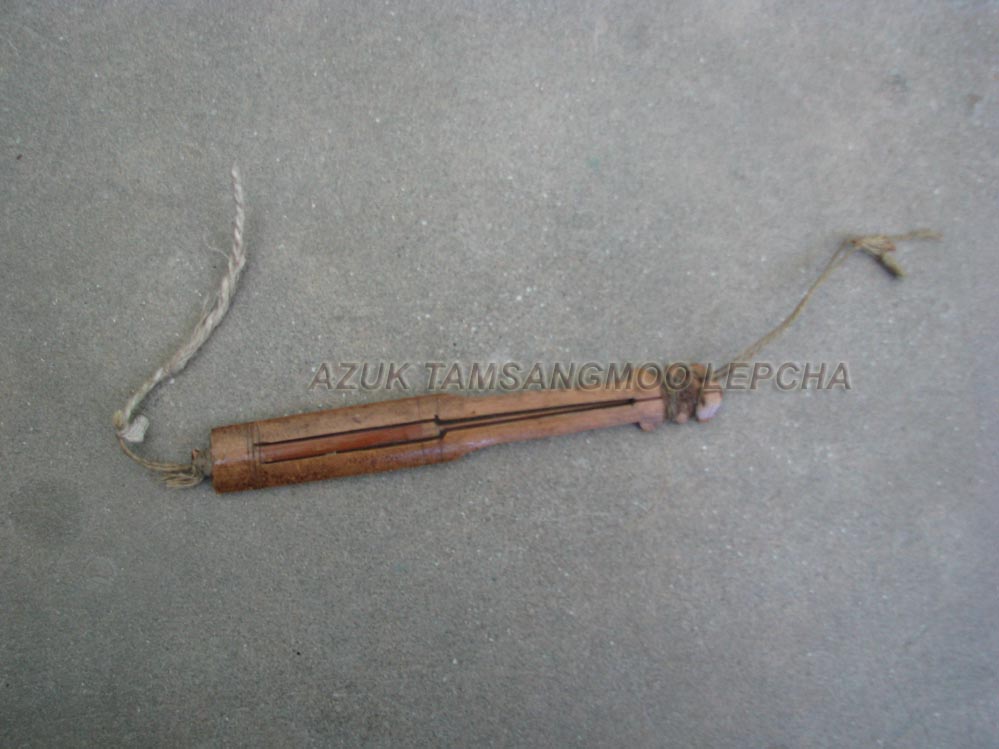
Length-16 inches.


  FOREWARD:

 The above facts about these Lepcha musical instruments were collected by Ren Lapun S.T. Tamsang lepcha during his casual conversation during his extensive travel in Sikkim, Darjeeling dist, Elam and the Terrai near Bhutan. His long so journey in the quest of knowledge about Lepcha music was worthwhile. He also met elderly Lepchas illiterate but still rich with knowledge of our ancient heritage and therefore able to orally communicate to him these precious bits of information before it became buried with the past. This rich harvest of past history encouraged him to delve deep enough to be able to collect a little more than 400 folk songs and about 60 folk dances. The different musical instruments were used in particular occasions. For example the “Panthong Palit” was played during festive occasion of marriage and during the joyous return of warriors. It was a welcome note that sounded its sweet music in the very early hours of dawn, apparently the instrument is never played during daytime. The Nibrok (double barrelled flute) was played to welcome dignitaries like kings prince and princess of neighbouring regions. The Bangho originally used to convey message over the hills to different villages is now used in religious performances in monastries. The Tungdarbong is now used by the Lepcha priestress “Mun” during her incantation. The suno is also used as the instruments to play the joyful tune of welcome to dignitories. Bampathyut is used by hunters while poaching in order to signal messages to eachother. The Popatek is made of bamboo. It has slit in the middle and it resembles the modern instrument, “Merica.


   The following are the names of the Lepcha people from where he gathered the above information regarding Lepcha musical instruments:-

 1)     Mr. Dunsong - (96 yrs. old) Daramdin, West Sikkim.
 2)     Mandal Lachen Thingthompacho (91yrs. old) Dzongu, Penthong.
 3)     Mr. Tuknilmoo(75yrs. old) Disa Busty. Ellam, Nepal
 4)     Mr. Deeda Lepcha (99yrs. old) Namthang Sikkim.
 5)     Mr. Pema Dorjee Namchumu (96 yrs. old) Darjeeling Pokhrebong Busty.
 6)     Mr.Gogo bongthing Foyingmu(86 yrs old) Gitdabling, Kalimpong.
 7)     Mr. Sangdo Golukmu - 81 yrs. old) Gitdabling, Kalimpong.
 8)     Mr. Namgna Dorjee (76 yrs. old) Rumchetpacho. Dzongu, Sikkim.
 9)     Mr. Ramdal Rai (112 yrs. old) Gorubathan, Pankhasary Busty.


 Their age when he met them.


AZUK TAMSANGMOO LEPCHA