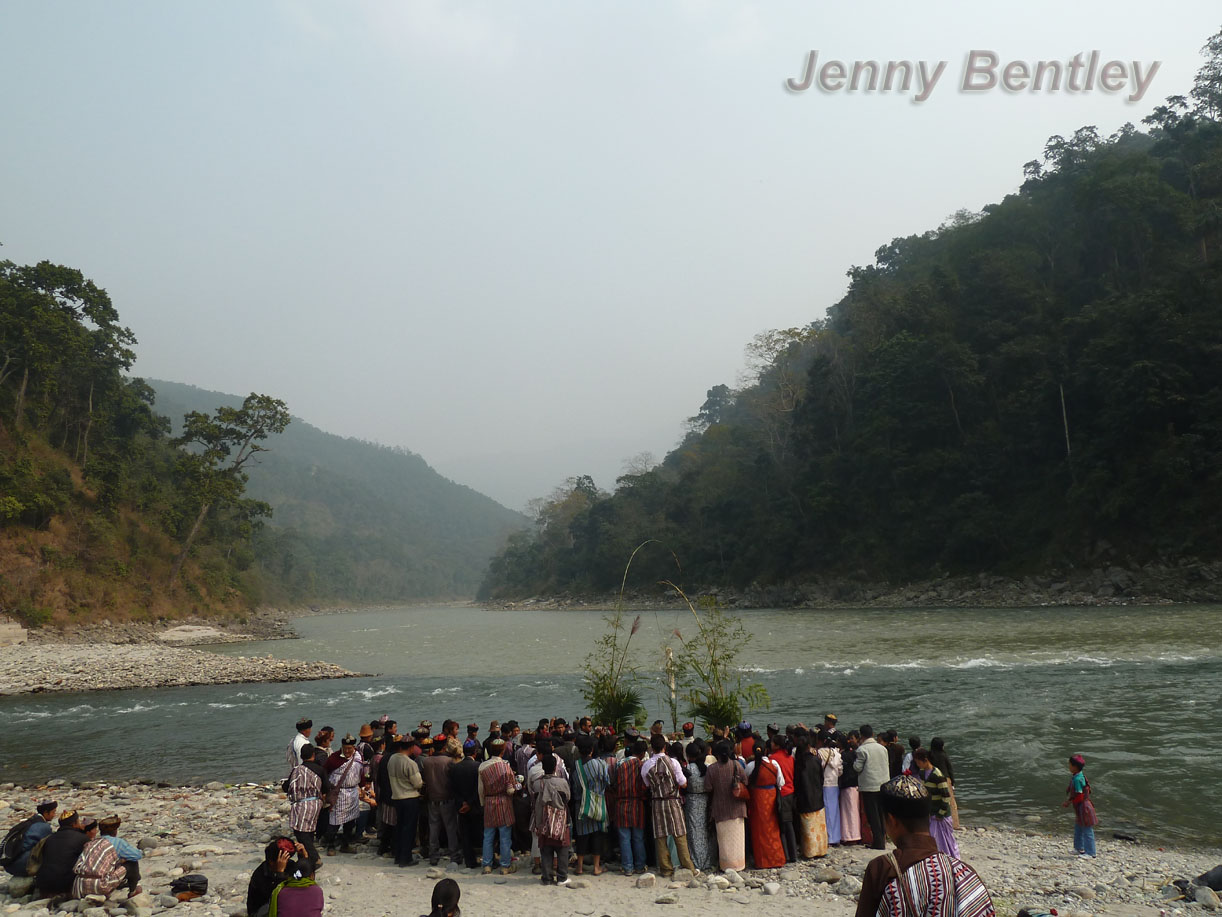
The pattern and balance of relationships between insects, birds, fish, animals and the Lepchas and their surroundings i.e. the sun, air, wind, earth, soil, sands, stones, mist, cloud, rain, water, rivers, mountains, hills, valleys, trees, shrubs etc. are very very strong indeed. The Lepchas are truly nature-lovers and worshippers.
What is Muk Zek Ding Rum Faat? The Lepchas love, respect and worship Mother Nature. Muk Zek Ding Rum Faat can be discribed as the prayers and offerings to Mother Nature. It is a Lepcha festival with education in ecology and environment. The ‘Mun’ (Lepcha Priestess), and Boongthing (Lepcha Priest), and their loyal followers invoke and offer their prayers to Mother Nature during the month of February each year for timely mist, cloud, rain, sunshine, clean air and water to make the soil and earth fertile so that healthy plants, trees and shrubs may grow in profusion to provide the insect, worm, bird, fish and animal world including humans with ever indispensible flowers, fruits, medicines, cereals, food, shade and shelter as well as protect and save them from natural calamities, disasters like earthquakes, landslides, floods, famine and diseases.
Both the Mun and Boongthing invoke Mother Nature and request energy, on behalf of all the living things on earth for their growth, movement and life. They further ask her for power and for a constant and regular recycling process and balance of the other elements like the sun, air, soil or earth, water, green plants, worms, insect, birds, animals etc. to live and grow.
The Lepchas have given their own terms and names for different elements and their types; and these terms and names are used by the Lepchas during their daily prayers and offerings to Mother Nature. The Lepchas extensively use ‘Tungbaor Ring’ meaning figurative speech during their prayers and offerings. A few examples are given as follows:
Ordinary Lepcha word Tungbor Ring (Figurative Speech) English
1. Oong Maartik Moo Nyoo Water
2. Mee Tuk Byer-Tuk kal Moo Nyoo Fire
3. Sukmut Sung Doo Sung Ing Moo Nyoo Air or wind
4. Sutsuk Sutsuk-Samick Sun
5. Faat Numput Moo Nyoo Soil
6. Long Sa Ngoot Moo Nyoo Stone
7. Kumbyaong Kumbu-Kumsho Moo Nyoo Cloud etc.
The Mun and Boongthing also tell and preach to their loyal followers not to destroy the plants, trees, wild animals, birds, worms, fish, insects etc. indiscriminately; they constantly encourage their followers to learn to protect, save and love them instead because they warn that deteriorating ecological and environmental conditions will give rise to untold misery to this world in the future.
Because of the ‘Muk Zek Rum Faat’, the Lepchas from time immemorial, are very conscious of the importance of ecology and their surroundings. The Lepchas do care, love, respect and sometimes they also fear the nature and its wrath. They also very clearly understand that taking and destroying things, both animate and inanimate, of the natural world in excess is very harmful and has negative effects and repercussions on them. The Lepchas have learnt to take the essentials of life only from Mother Nature.
No wonder the world-famous botanist and naturalist, Dr. J.D. Hooker of Kew Gardens, England and General G.B. Mainwaring, the Champion of the Lepchas, have aptly remarked in their famous books ‘Himalayan Journals’ and ‘A Grammer of the Rong (Lepcha) Language as it exists in the Dorjeling and Sikkim Hills’ respectively that the Lepchas are born naturalists, botanists and nature worshippers.
Lyangsong Tamsang
*~*~*~*~*~*~*~*~*~*~